
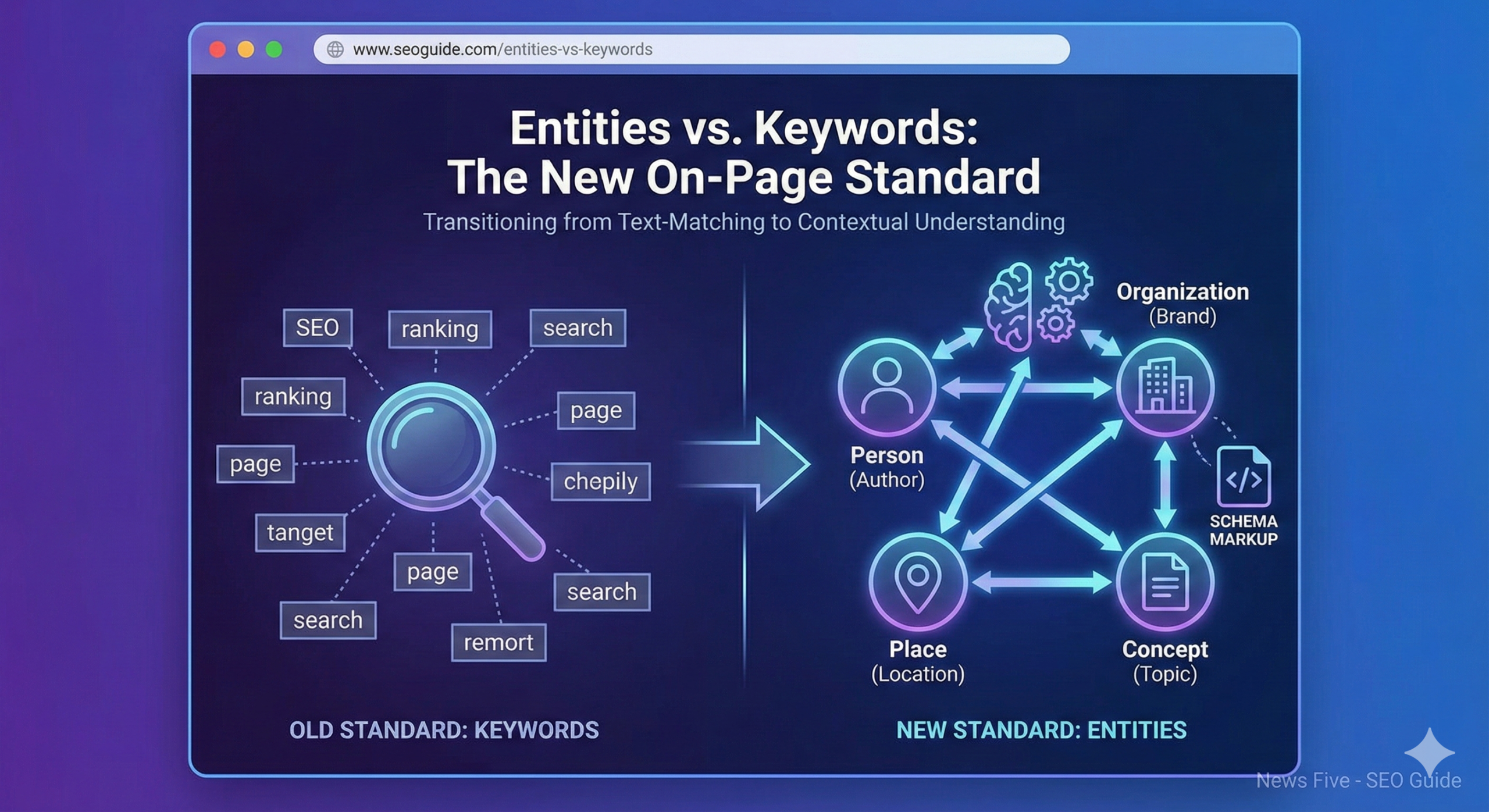
Search engine optimization has evolved significantly over the last decade. In the past, ranking high on Google was a simple game of matching exact words on a page.
Today, search engines have become smarter, moving away from simple text matching to understanding the real-world connections between ideas. This shift marks the transition to Entities vs. Keywords: The New On-Page Standard, a concept that is redefining how we approach on-page SEO.
To stay ahead, website owners must understand that Google no longer just reads your content; it understands the context, people, places, and things—known as entities—that make your content valuable.
What Are Entities in SEO?
In simple terms, an entity is a “thing” that is unique and well-defined. It can be a person (like “Elon Musk”), a place (like “Paris”), an organization (like “Tesla”), or a concept (like “Digital Marketing”).
Unlike keywords, which are just strings of letters, entities have meaning and relationships independent of the language used to describe them.
For example, if you search for the word “Jaguar,” a traditional keyword-based engine might struggle to know if you mean the animal or the luxury car.
However, an entity-based engine looks at the context. If the surrounding content mentions “speed,” “engine,” and “road,” it identifies the entity as the car. If it sees “jungle,” “predator,” and “spots,” it identifies the animal.
When Did the Shift from Keywords to Entities Happen?
The move toward entities did not happen overnight. It began seriously with Google’s Hummingbird update in 2013, which focused on semantic search—understanding the intent behind a query rather than just the individual words.
Later, the introduction of the Google Knowledge Graph accelerated this change. The Knowledge Graph is a massive database that understands facts about people, places, and things and how they are connected.
More recently, algorithms like BERT and MUM have further refined Google’s ability to understand natural language. These updates have made entities the backbone of modern SEO strategies.
How Do Entities Differ from Keywords?
Understanding the difference is crucial for your content strategy.
- Keywords are the specific terms users type into a search bar. They can be ambiguous and vary by language.
- Entities are the underlying concepts behind those keywords. They are universal and carry specific attributes.
Think of it this way: “The President of the United States” is a keyword phrase that changes every few years. The specific person holding that office at a specific time is the entity.
By optimizing for the entity, you ensure your content remains relevant and accurate to the search engine’s understanding of the world.
Why Are Keywords No Longer Enough?
Relying solely on keywords has limitations. Keyword stuffing, or repeating the same phrase multiple times, often leads to poor user experience and penalties from Google.
Furthermore, voice search and mobile usage have changed how people search. Users now ask complex questions like, “Who is the CEO of the company that makes the iPhone?”
A keyword-based engine looks for the exact words “CEO,” “company,” “makes,” and “iPhone.” An entity-based engine understands the relationship: Steve Jobs (past entity) or Tim Cook (current entity) $\rightarrow$ CEO (role) $\rightarrow$ Apple (organization) $\rightarrow$ iPhone (product).
To rank in this new era, your content must clearly map these relationships.
How to Optimize Your Content for Entities?
Optimizing for entities requires a shift in mindset. You are no longer just writing for a search crawler; you are building a resource that defines a topic clearly.
1. Build Comprehensive Topic Clusters
Don’t just write a single blog post about a broad keyword. Create a “pillar page” that covers the main entity in depth. Then, create supporting articles that link back to this pillar. This signals to Google that you are an authority on the entire topic, not just a single keyword.
2. Use Structured Data (Schema Markup)
Structured data is the language of entities. By adding Schema.org markup to your HTML, you explicitly tell Google what your content is about. You can tag specific entities like an Organization, Person, or Event. This removes ambiguity and helps Google add your content to its Knowledge Graph.
3. Focus on Natural Language and Context
Write naturally. Use synonyms and related terms (LSI keywords) that support the main entity. If you are writing about “Apple” (the brand), naturally mention terms like “MacBook,” “iOS,” “Cupertino,” and “Tech Industry.” These co-occurring terms confirm the context for the search engine.
4. Optimize Your “About Us” Page
Your brand is also an entity. Make sure your “About Us” page is detailed. List your awards, office locations, and key team members. Link to your social media profiles and other authoritative sources where your brand is mentioned. This strengthens your E-E-A-T (Experience, Expertise, Authoritativeness, and Trustworthiness).
What Is the Role of the Knowledge Graph?
The Knowledge Graph is Google’s way of organizing the world’s information. When you search for a famous person and see a box on the right side of the results with their photo, bio, and social links, that is the Knowledge Graph in action.
Getting your brand or content into this graph is the ultimate goal of entity SEO. It signifies that Google trusts your data enough to present it as a fact. You can influence this by having a Wikipedia page, a verified Google Business Profile, and consistent information across all digital platforms.
Conclusion: The Future of On-Page SEO
The transition to Entities vs. Keywords: The New On-Page Standard is not just a trend; it is the evolution of a smarter web. While keywords will always play a role in how users express their needs, entities are how search engines understand the solution.
By shifting your focus to building topical authority, using structured data, and writing comprehensive content that maps out clear relationships, you future-proof your SEO strategy. Start treating your website as a knowledge base, and Google will reward you with better visibility and higher rankings.
Leave a Reply