
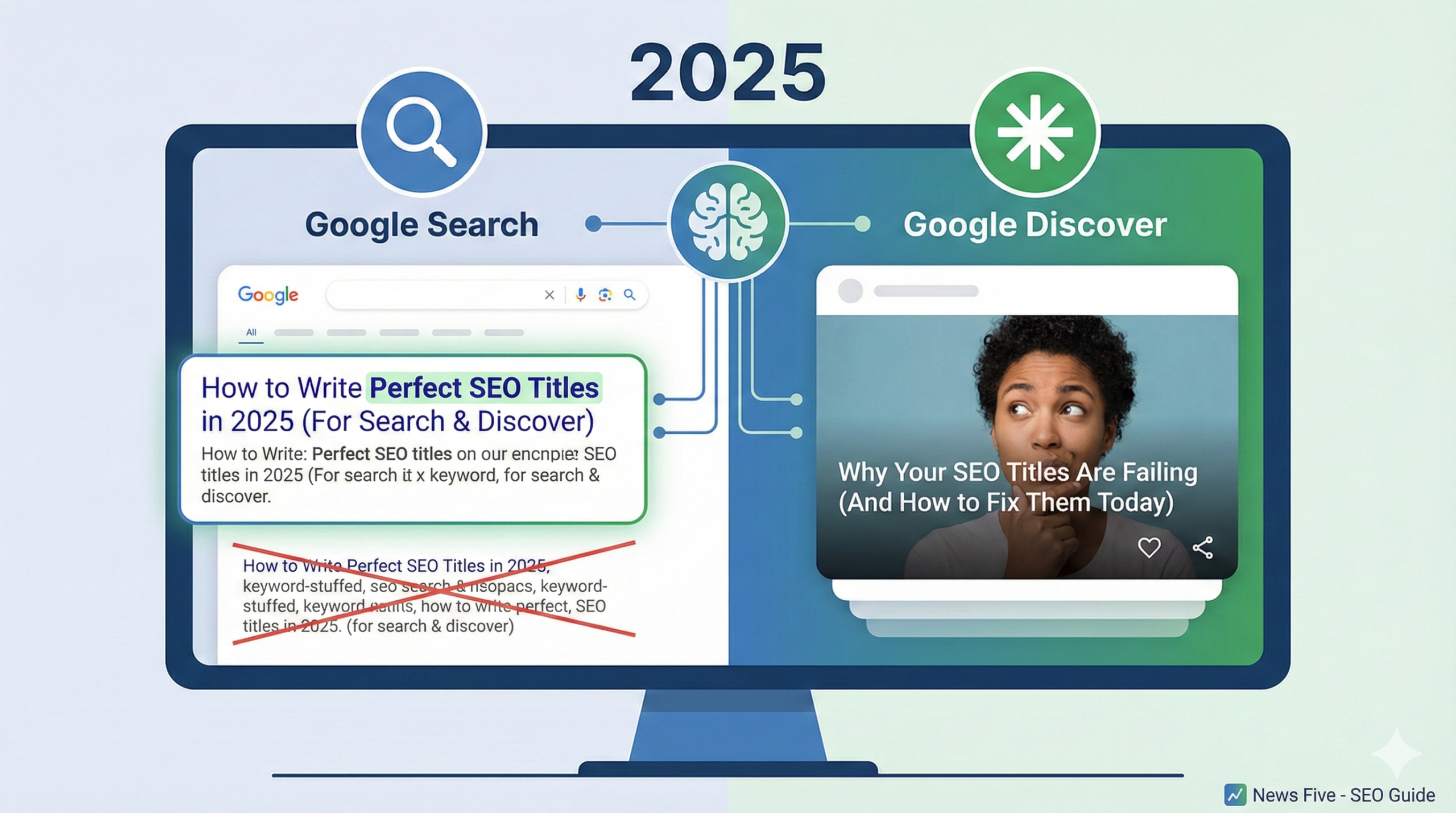
When you publish a new page on the internet, the Page Title (or HTML Title Tag) is the very first thing Google Bot analyses. It is also the first interaction a human user has with your brand or your website. Think of it as the digital handshake between your content and the world. If you want to know how to write perfect SEO titles in 2025, you must understand that modern SEO is no longer just about keywords; it is about psychology and engineering combined.
Why “Keyword Stuffing” Doesn’t Work Anymore
For a long time, many people thought a solid On Page SEO strategy was simply copying and pasting the same word multiple times. If you wanted to rank for “Best SEO Courses,” you would write “Best SEO Courses” three times in the header. That method, known as “Exact Match SEO,” is obsolete.
As an SEO Expert who has watched search algorithms evolve over the last 12 years, I can tell you that Google’s systems now mimic the human brain. Today, search engines look for Search Intent. They do not just count words; they try to understand the meaning behind them.
If your title is just a list of keywords, it looks like spam to both the algorithm and the user. It lacks context. Google prefers Natural Language Processing (NLP)—titles that sound like a human wrote them for another human. If you focus on relevance and user experience, the ranking will follow.
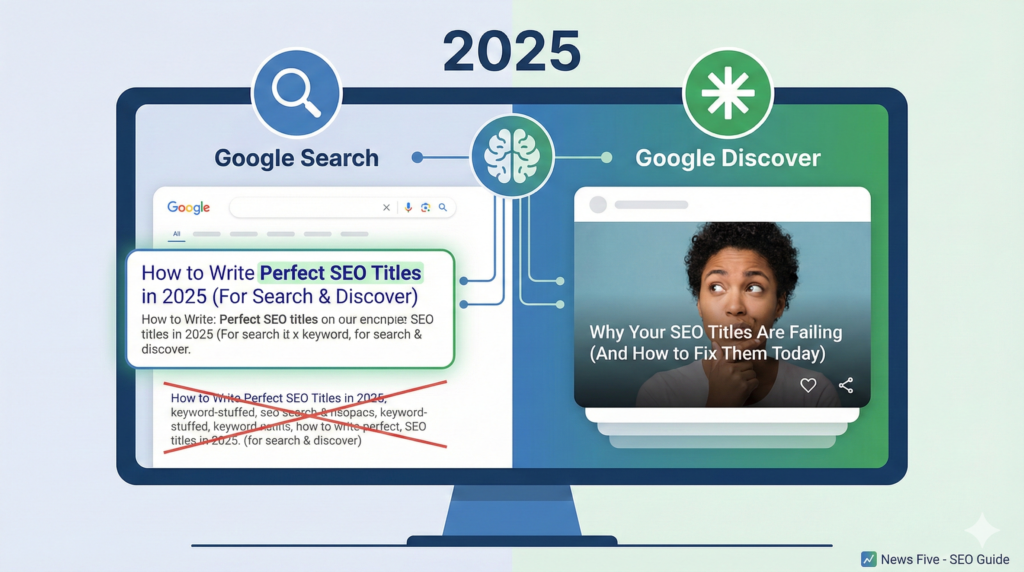
What is the “Front-Loading” Rule for Mobile SEO?
One of the most critical technical limitations you need to respect in 2025 is screen size. Most people searching on Google today are using a mobile device. Mobile screens are narrow and have a strict pixel limit.
Google typically displays only the first 50–60 characters of a title tag. If your title is too long, the search engine applies truncation. This means the end of your sentence is cut off and replaced with an ellipsis (“…”).
This hurts your scannability. Users scroll very fast on mobile. If they don’t see the main topic immediately, they keep scrolling. To fix this, use the “Front-Loading” rule. Put the most important subject or keyword at the very beginning of the sentence.
- Bad Example: A Comprehensive Guide on the Best Way to Do Gardening. (The main topic “Gardening” is hidden at the end).
- Good Example: Gardening Guide: The Best Tips for Beginners. (The main topic is first).
By putting the main entity first, you ensure it is visible on every screen size, guaranteeing a strong first impression and a higher Click-Through Rate (CTR).
How to Choose Semantic Words That Google Understands
Google is a machine that relies on clarity. If you use words that are vague or confusing, the algorithm assigns low confidence to your page. To rank well, you need to establish Topic Authority.
This means proving you know what you are talking about by using specific, semantic vocabulary rather than generic terms.
Specific vs. Generic Keywords
- Generic (Weak): “How to Fix Your Phone.” (Which phone? What problem? This has high ambiguity).
- Specific (Strong): “How to Fix iPhone 15 Battery Drain.” (This targets Long-tail Keywords and has zero ambiguity).
Before you write, briefly check the search volume and competition. Often, it is better to be very specific and own a smaller niche than to be generic and invisible. Don’t be afraid to use synonyms. Google is smart enough to know that “Jogging” and “Running” are semantically related. You don’t need to jam both words into the title; just pick the one that fits the user’s natural language best.
How to Get More Clicks on Google Discover
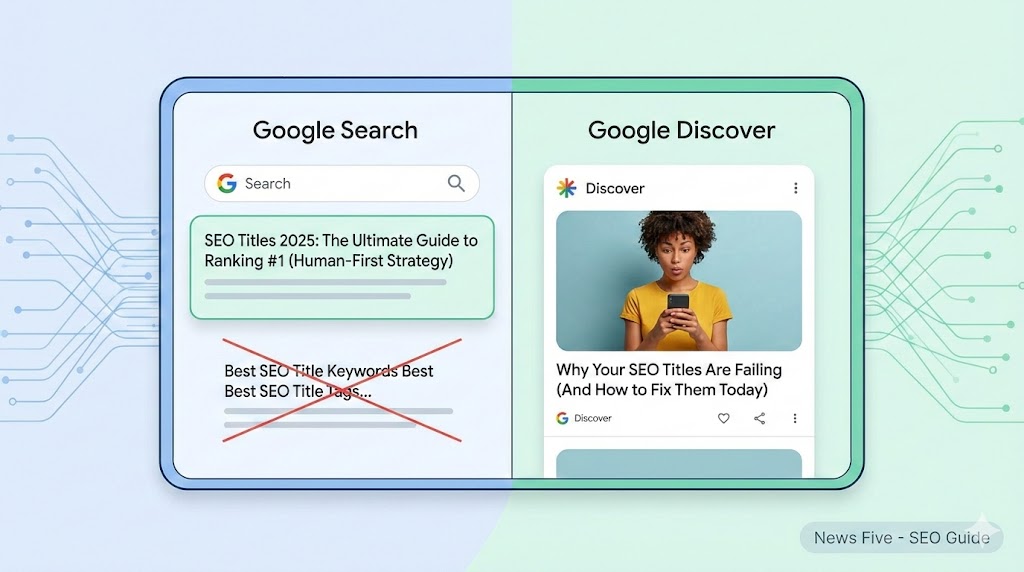
While Google Search is about answering specific questions, Google Discover is about feeding interests. It functions more like a social media feed.
To win here, you need high engagement. Titles for Discover need an Emotional Hook. They shouldn’t be boring, but they must also remain accurate. They need to spark curiosity without crossing the line into deception.
- Search Title: “10 Tips for Better SEO.”
- Discover Title: “Why Most SEO Advice Fails (And What Actually Works).”
The second title drives curiosity. It taps into a trend or a feeling of “Missing Out.” However, be very careful with clickbait.
The Difference Between Good and Bad Clickbait
- Good Clickbait: Delivers exactly what is promised in the headline, just in an exciting way.
- Bad Clickbait: Lies to the user or exaggerates wildly.
If users click your article and immediately leave (pogo-sticking) because the title was a lie, Google will stop showing your content. Always ensure your title text matches the context of your feature image, as visuals are dominant in the Discover feed.
When Does Google Rewrite Your Title Tags?
Sometimes, you write a perfect title, but when you look at the SERP (Search Engine Results Page), you see something different. This is called a “Rewrite.”
Google’s algorithm rewrites titles when the system thinks the original title is:
- Empty or missing in the HTML code.
- Inaccurate or doesn’t match the main content of the page.
- Stuffed with too many repetitive keywords.
When Google rewrites a title, it usually grabs the H1 Tag (the main headline on your page) or the anchor text from inbound links pointing to you.
How to Prevent Rewrites
Make sure your title is a descriptive, concise summary of the page. If your title is simply “Home – NewsFive,” Google will rewrite it because that tells the user nothing. If you want to keep your brand name in the title, put it at the very end, separated by a separator like a dash or pipe (e.g., “SEO Tips 2025 | NewsFive”).
3 Examples: Good vs. Bad Title Tags
The best way to learn SEO writing is by comparison. Here are three examples showing how to turn a bad title into a best-practice winner that satisfies both the algorithm and the user.
Example 1: The Recipe
- ❌ Bad: “Delicious Cake Recipe for You to Bake Today”
- Why: Too much fluff. “Delicious” is subjective. “For you” is wasted pixel space.
- ✅ Good: “Moist Chocolate Cake Recipe: Easy & No-Mixer (2025)”
- Why: Uses specific entities (Chocolate, No-Mixer). Uses Power Words (Moist, Easy). Includes the year for freshness.
Example 2: The Tutorial
- ❌ Bad: “SEO Guide”
- Why: Too short. Zero information gain. It does not tell the user what kind of guide it is.
- ✅ Good: “SEO for Beginners: A Step-by-Step Guide to Ranking #1”
- Why: Defines a clear audience (Beginners). Promises a clear result (Ranking #1). Defines the format (Step-by-Step).
Example 3: The News Update
- ❌ Bad: “New Phone Release Date”
- Why: Which phone? This is too vague for any search engine to rank effectively.
- ✅ Good: “iPhone 16 Release Date: Leaks, Price & Specs Rumors”
- Why: Targets multiple search intents (Leaks, Price, Specs). Uses a separator (:) to organize the data for quick scanning.
Final Thoughts: The “Human” Algorithm
The secret to a perfect title isn’t a hack. It isn’t a magic line of code or a specific keyword density. The secret is empathy.
When you write a title, ask yourself: “If I were in a hurry and looking for this answer, would I click this?”
If the answer is yes, the algorithms will likely agree with you. Focus on the user, keep your structure simple, and the organic traffic will follow.
Leave a Reply