
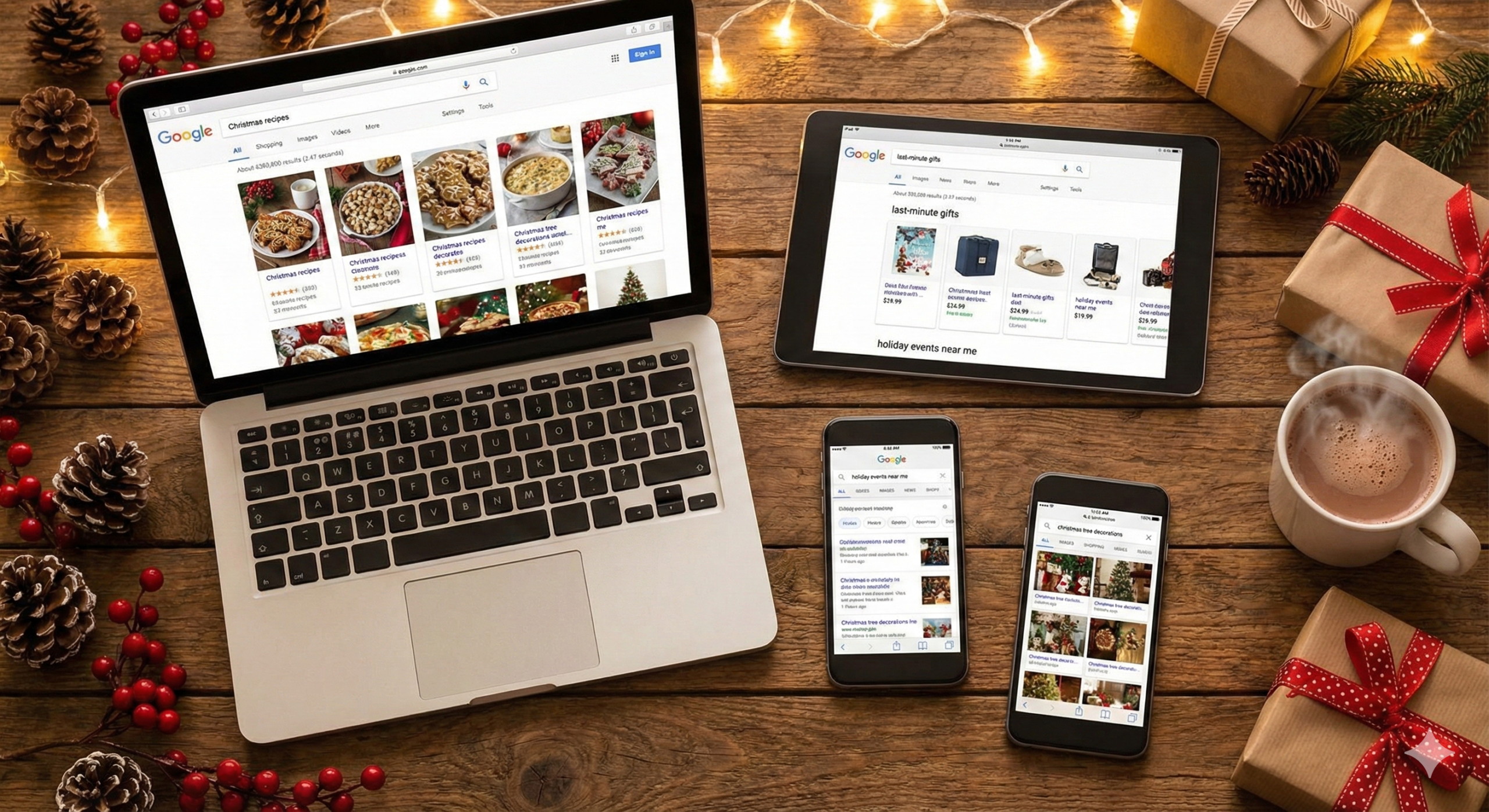
As we approach December, understanding SEO for Christmas holidays becomes crucial for every digital marketer.
With 12+ years of experience handling end-to-end SEO campaigns for retail, ecommerce, and B2B sectors, I have seen firsthand how the festive season dramatically alters user behavior.
It is not just about traffic spikes; it is about the shift in search intent—from research to urgent transactional queries. This guide covers how search volume fluctuates, the specific days traffic drops, and how businesses can leverage these trends for maximum conversion rate optimisation (CRO).
Understanding Search Volatility During the Festive Season
The holiday season acts as a massive disruptor to standard search patterns. For most industries, December is not “business as usual.” We observe a distinct split in performance based on the domain.
- B2C (Business to Consumer): Ecommerce, retail, and local businesses typically see a massive surge in holiday search trends starting from Black Friday, peaking in mid-December, and seeing a unique behavior on Christmas Day itself.
- B2B (Business to Business): Sectors like ERP, construction, and digital agencies often witness a slowdown. Decision-makers go on leave, and search volume for technical terms dips as the focus shifts to Q1 planning.
What Does the Data Say About Christmas Search Traffic?
Data drives our SEO decisions. Historical analysis of search engine algorithms and user traffic reveals a consistent pattern during the Christmas week.
- The Pre-Christmas Rush: From December 1st to December 20th, “transactional” keywords (e.g., “buy,” “deal,” “delivery”) peak. Mobile traffic share often exceeds 56%, making mobile optimisation non-negotiable.
- The Christmas Dip: On Christmas Eve (Dec 24) and Christmas Day (Dec 25), global web traffic typically drops by 20% to 50%. In the US and UK, this dip is most pronounced as users go offline for family gatherings.
- The Boxing Day Surge: Immediately on December 26th, traffic rebounds sharply (often +50% compared to Christmas Day) as users hunt for post-Christmas sales and redeem gift cards.
How Do Search Trends Shift in December?
The most critical factor for a content SEO specialist is understanding the evolution of user intent. You cannot target the same keywords in December that you did in October.
- October (Awareness): Users search for “gift ideas” or “best holiday trends.”
- November (Consideration): Users look for “reviews,” “price comparisons,” and “Black Friday deals.”
- December (Urgency): The semantics change to “next day delivery,” “last minute gifts,” and “open now.”
How Can Businesses Leverage Holiday Search Trends?
Businesses must pivot their onpage SEO and content strategies to align with this behavior. Here is how I handle this for clients:
1. Optimize for “Urgency” Keywords
Update your meta titles and descriptions to include phrases like “Guaranteed Christmas Delivery” or “24-Hour Shipping.” This directly impacts your Click-Through Rate (CTR) when users are panic-buying.
2. Local SEO is King
For brick-and-mortar stores, local SEO is vital. Update your Google Business Profile (formerly GMB) with special holiday hours. Use keywords like “Christmas shops near me” or “Holiday events in [City Name].”
3. Technical SEO & Core Web Vitals
With the traffic spike comes server load. Ensure your front end technologies (HTML, CSS, JavaScript) are optimized. Minify resources to ensure your landing page optimisation holds up under pressure. A slow site during the holidays is a lost customer.
4. The B2B Strategy
If you are in B2B, do not stop. Use this quiet period to publish “Year in Review” content or “Trends for 2025.” This builds authority and keeps your brand visible when decision-makers return in January.
When Does SEO Traffic Return to Normal?
Many clients ask, “When will my traffic recover?”
For B2C, the traffic never really stops; it just morphs into “New Year Sale” interest immediately after Christmas. For B2B, traffic typically normalizes by the second week of January.
Note: Do not pause your link-building campaigns. December is an excellent time for offpage SEO as many bloggers and journalists are looking for “end-of-year” roundups to feature.
Routine Outline: Your Holiday SEO Checklist (Ready to Copy)
Below is the exact outline I use for my clients. You can copy this structure to ensure your website is 100% ready for the holiday search demand.
Phase 1: Technical Health Check (Dec 1 – Dec 5)
- [ ] Speed Test: Run PageSpeed Insights. Ensure LCP (Largest Contentful Paint) is under 2.5s.
- [ ] Mobile Audit: Verify checkout flows work perfectly on mobile devices.
- [ ] Schema Markup: Add
OfferandshippingDetailsschema to product pages to show price and delivery times in SERPs.
Phase 2: Content & Onpage Optimization (Dec 5 – Dec 15)
- [ ] Keyword Injection: Add semantic keywords: “Holiday sale,” “Gift guide,” “Christmas delivery.”
- [ ] Internal Linking: Link your high-traffic blog posts (e.g., “Best Gifts 2024”) to your main product pages to pass link juice.
- [ ] Landing Pages: Create a dedicated “Holiday Deals” landing page.
Phase 3: The Final Push (Dec 15 – Dec 24)
- [ ] Update Meta: Change titles to reflect shipping cut-off dates (e.g., “Order by Dec 20 for Xmas Delivery”).
- [ ] Local Updates: Update Google Maps hours to “Open” or “Closed” for holidays to avoid bad user experiences.
Phase 4: Post-Christmas Prep (Dec 26 onwards)
- [ ] 301 Redirects: If products go out of stock, redirect users to similar category pages, do not show 404 errors.
- [ ] Sales Content: Launch “Year End Sale” banners and content immediately.
Conclusion
Search during the Christmas holidays is volatile but predictable. By understanding the data—knowing that traffic will dip on the 25th but skyrocket on the 26th—you can plan your end-to-end SEO campaigns effectively. Whether you are using JavaScript frameworks or simple HTML/CSS sites, the fundamentals remain: fast speed, high relevance, and adapting to user urgency.
Leave a Reply